Tooling
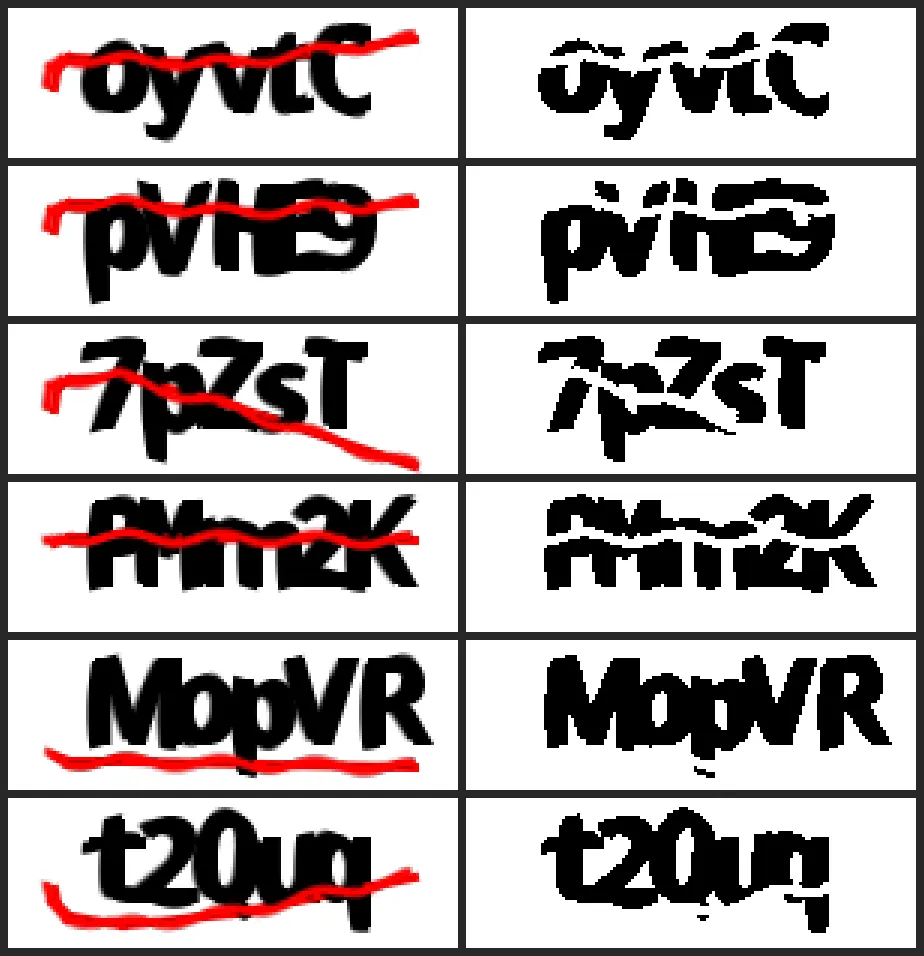
CAPTCHA reader for public-data collection
Brazilian public environmental portals demand a CAPTCHA for every single file you download. I trained the model that reads it and took the human out of the loop.
82%
of CAPTCHAs accepted on the first try by the server itself, with the right letter case
- Conditions
- 41 of 50 CAPTCHAs · ensemble of 4 models · acceptance confirmed by the server, not by an answer key of mine · with n=50 the 95% interval runs from 69% to 90%, so read it as "around 80", not as a hard 82
- Role
- Author of the model, inside the company's repository
- Context
- Datlaz — contract work
- Period
- 2026
- Status
- In production since July 2026
The problem
Datlaz builds geospatial layers out of Brazilian public data, and most of those portals charge a text CAPTCHA for every file you download. There are tens of thousands of files. The existing pipeline used a generic OCR with up to fifty retries per download — brute force, and every retry is a request hitting someone else’s server.
The part that decided the outcome
The server tells you whether your answer was right. That’s a free labeler: instead of annotating images by hand, I let the collector build its own training set. It produced 1,154 confirmed examples in fifty minutes, at roughly one second between requests and with no files downloaded during collection — the bottleneck was politeness, not speed.
The second finding changed the architecture. I suspected the server was case-sensitive and tested it, submitting everything lowercase, then everything uppercase: about 3% accepted in each run, 6% across both — exactly what chance predicts for five characters, since 2⁻⁵ is 3.1% per attempt. That means an OCR that ignores case is capped at around 7% there, no matter how well it reads the letters.
So the model has two heads: one decides which letter it is, the other decides whether it is uppercase. Splitting the two questions took case-correct accuracy from 12% to 44% on the same test set; the rest came from more real data and from four models voting.
The result
82% accepted on the first try, over 50 CAPTCHAs, against the live server. Since the download can retry, in practice the file comes through: that works out to about 1.2 attempts per CAPTCHA, against the up-to-fifty attempts it used to take.
It runs on 26 MB of model and about 10 milliseconds per CAPTCHA on a single CPU core, with no GPU in production. The model runs inside the company’s own infrastructure, in ONNX — no third-party service call, no paid solving service. Two direct consequences: the cost per CAPTCHA is zero once training is done, and no image ever leaves the operator’s network.
The second one, which needed no neural network at all
Another portal, another CAPTCHA, same need. Before training anything I looked at the image: single font, characters in fixed-width cells, no distortion and no noise. It did not need a neural network — comparing bitmaps and picking the nearest one was enough. 26 KB of templates, 92% accuracy over 200 attempts, about 1 millisecond per CAPTCHA.
It’s worth recording the trap I nearly fell into. On the self-labeled set, cross-validation scored 99%. That is a lie: the set only contains CAPTCHAs some model had already got right, so it measures the easy ones. The number that counts is the 92% measured against the server, with the hard ones still in.
The limits
The repository belongs to the company and is private. I wrote the CAPTCHA solver and fixed two collection defects along the way — I am not the author of the collector, which already existed. Across the solver directories, four of the five commits are mine.
And I do not publish the portals’ addresses or parameter names. The method is described here; the map for abusing it is not.