Fabrication & 3D
Photo-based 3D scanner
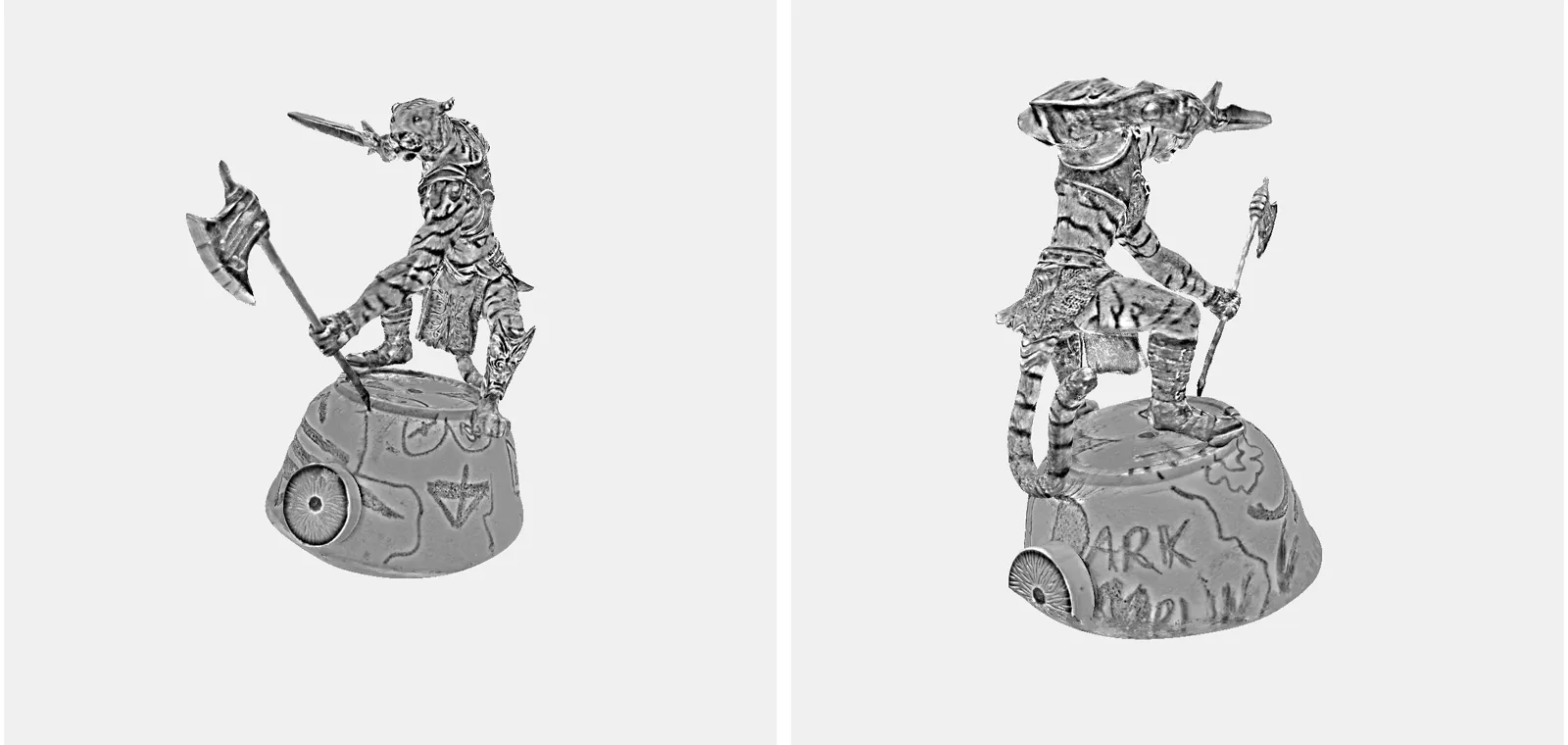
You photograph a painted miniature with your phone and get back its mesh, ready for Blender and for the resin printer — with no desktop scanner involved.
US$0.70
the GPU cost to digitize one piece, after I measured that the four-hour version was no better
- Conditions
- rented RTX 4090 at US$0.69/h · half resolution · the 4h09 full-4K mesh differed by 0.010% of the diagonal, below the voxel
- Role
- Author, own project
- Context
- A need at Octus Forge, my resin printing company
- Period
- 2026
- Status
- Working prototype · one piece scanned and approved
The problem
Octus Forge prints resin pieces, and a request came in that we couldn’t fulfill: replicate a miniature that already exists, painted, in the customer’s hands. Desktop scanners are expensive and choke on exactly the fine detail that matters on a seven-centimeter figure. The question was whether we could solve it with what we already had — a phone and a GPU rented by the hour.
How it works
You photograph the piece while orbiting around it. The photos go into COLMAP, which works out where the camera was for each one. Gaussian Splatting reconstructs the scene, a TSDF fusion turns that into a mesh, and Blender ends up with an OBJ plus an 8192×8192 displacement map. On the first piece: 469 photos, a watertight mesh of 4.5 million faces, scale anchored at 114.44 mm.
None of this goes through a third-party API. The models run on my own stack, on a GPU rented by the hour — I pay for compute, not per call. That is what keeps the cost per piece predictable instead of tied to somebody’s price list.
The decision that changed the project
Before trying to improve the reconstruction, I measured what the capture could actually support. I wrote a ruler that compares independent photos looking at the same 3D point and answers, in millimeters, the size above which detail repeats — and therefore exists. The answer was harsh: a single photo only carries reliable information above 1.2 mm. Below that, what shows up in the mesh is the algorithm inventing detail, however convincing it looks on screen.
That ruler killed entire lines of work, including my own. I had a displacement map that had been approved by eye, and the measurement showed it carried 13% more detail than the source pixels could support: part of what people liked was JPEG compression ringing turned into relief.
It also killed full 4K. Four hours of GPU at full resolution produced a mesh that differed from the one-hour version by 0.010% of the diagonal — below the voxel size, so indistinguishable. Four hours that bought nothing, and a production default that dropped to seventy cents a piece.
What it is not
It is not a product and it is not published. It runs on COLMAP, a GPU and someone who knows what they are doing. The splatting engine is third-party — PGSR, from ZJU — and no algorithm here is new; what is mine is everything around it: the capture control, the measurement and the finishing. And everything written above was measured on one piece and one capture. I still do not know what happens with glass, with matte black, or with a piece three times the size.
The part that stood on its own became open source, as pgsr-fast.